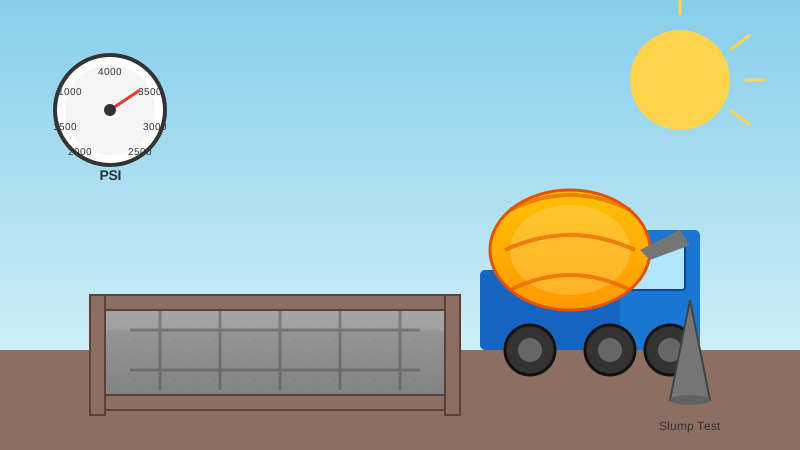
Concrete is not just cement, water, and stone. Strength, workability, and mix design change how it pours and how it lasts. Know the PSI, slump, and mix before you order a truck or approve a load.
What is Concrete PSI?
PSI stands for Pounds per Square Inch—a measure of concrete’s compressive strength. This is how much weight the concrete can withstand before it fails. The higher the PSI, the stronger the concrete.
Concrete strength is commonly specified and tested at 28 days after pouring. This is the standard test age used to verify design strength.
Common PSI Ratings and Applications
| PSI Rating | Typical Applications |
|---|---|
| 2,500 PSI | Residential footings, patios, non-structural slabs |
| 3,000 PSI | Driveways, sidewalks, residential slabs (minimum code requirement) |
| 3,500 PSI | Structural slabs, garage floors, residential foundations |
| 4,000 PSI | Commercial floors, driveways with heavy traffic, industrial applications |
| 4,500 PSI | Warehouses, parking structures, heavy-duty industrial |
| 5,000+ PSI | High-rise buildings, bridges, specialized structures |
What the Building Codes Require
Many jurisdictions specify minimum compressive strength for slab-on-grade concrete. A common residential baseline is around 3,000 PSI at 28 days, but requirements vary. Many contractors recommend upgrading to 3,500 PSI or 4,000 PSI for:
- Garage floors (vehicle weight and potential oil spills)
- Driveways (freeze-thaw cycles and vehicle loads)
- Pool decks (chemical exposure)
- Exterior slabs in cold climates
How PSI is Achieved
Concrete strength depends on several factors:
- Water-to-cement ratio – Lower ratio = higher strength
- Cement content – More cement generally means more strength
- Aggregate quality – Clean, well-graded aggregates improve strength
- Curing conditions – Proper moisture and temperature are critical
- Age – Concrete continues to strengthen over time
Understanding Slump: The Workability Factor
What is Concrete Slump?
Slump measures concrete’s consistency and workability?how easily it flows. Workers fill a cone-shaped mold with fresh concrete. Then they lift the mold and measure how far the concrete slumps.
A higher slump means wetter, more fluid concrete. A lower slump means stiffer, less workable concrete.
Standard Slump Values
| Slump | Description | Typical Use |
|---|---|---|
| 1-2 inches | Very stiff | Roads, pavements, mass concrete |
| 3-4 inches | Standard | Slabs, footings, walls (most residential) |
| 5-6 inches | Fluid | Pump applications, columns, ICF walls |
| 7+ inches | Very fluid | Specialized applications, self-consolidating |
Many residential mixes target about 3?4 inches of slump for slabs and footings. The exact spec still varies by placement method, admixtures, and finish requirements.
The Critical Relationship: Slump and Strength
Here’s the crucial point most homeowners don’t know:
If you add water to increase slump, you usually reduce strength and durability. Workability should come from proper mix design (or water reducers), not extra water.
This is why you should avoid adding water to ready-mix concrete at the job site. If you need higher workability for placement, ask the plant about a mix designed for pumping or a water-reducing admixture.
Acceptable Slump Variations
Slump tolerances should be defined in your project specs (ready-mix tolerances are often referenced to ASTM C94/C94M). If delivered slump is far from what was ordered:
- The quality may be significantly compromised
- You have the right to reject the load
- Document the issue before accepting delivery
Concrete Mix Design Explained
Mix design is the recipe that determines your concrete’s properties. The American Concrete Institute (ACI 211.1) provides industry-standard guidance for proportioning concrete mixes.
The Key Components
1. Portland Cement
- The “glue” that binds everything together
- Measured in bags (94 lbs) or pounds per cubic yard
- More cement = stronger concrete (but also more expensive and higher shrinkage)
2. Water
- Activates the cement through hydration
- The water-to-cement ratio (w/c) is critical
- Less water = stronger concrete
3. Coarse Aggregate (Gravel/Stone)
- Typically 3/4” to 1” in diameter
- Provides bulk and strength
- Must be clean and properly graded
4. Fine Aggregate (Sand)
- Fills voids between coarse aggregate
- Improves workability
- Should be clean and free of organic material
5. Admixtures (Optional)
- Air-entraining agents (for freeze-thaw resistance)
- Water reducers (improve workability without extra water)
- Accelerators (faster curing in cold weather)
- Retarders (slower curing in hot weather)
Common Mix Ratios
While exact proportions vary, here are typical ratios by volume:
| PSI Target | Cement | Sand | Gravel | Approx. w/c Ratio |
|---|---|---|---|---|
| 3,000 | 1 | 2.5 | 3 | 0.55 |
| 3,500 | 1 | 2.25 | 2.75 | 0.50 |
| 4,000 | 1 | 2 | 2.5 | 0.45 |
| 4,500 | 1 | 1.75 | 2.25 | 0.40 |
Note: These are approximations. Actual mix designs depend on local materials and should be tested.
Choosing the Right Concrete for Your Project
Residential Driveways
Recommended: 3,500-4,000 PSI with 4” slump
Why? Driveways face:
- Vehicle loads (2-6 tons per axle)
- Freeze-thaw cycles (in cold climates)
- Oil and chemical exposure
- UV exposure
Add air entrainment in freeze-thaw regions (4-6% air content).
Garage Floors
Recommended: 3,500-4,000 PSI with 4” slump
Considerations:
- Similar to driveways, plus indoor humidity control
- May need vapor barrier underneath
- Consider sealer for oil resistance
Patios and Walkways
Recommended: 3,000-3,500 PSI with 4” slump
Lower strength acceptable because:
- Lighter loads (foot traffic only)
- Decorative options may require different finishes
- Cost savings on non-critical areas
Foundations and Footings
Recommended: 3,000 PSI minimum (check local codes)
Requirements vary by:
- Soil bearing capacity
- Building loads
- Local frost depth
Always follow your engineer’s specifications for structural concrete.
Ready-Mix vs. Bagged Concrete
When to Use Ready-Mix
Ready-mix concrete delivered by truck is ideal for:
- Projects requiring more than 1 cubic yard
- Time-sensitive pours
- When consistent quality is critical
- Large slabs and driveways
Minimum order: Usually 1-2 cubic yards (some charge “short load” fees under 4 yards)
When to Use Bagged Concrete
Bagged concrete (Quikrete, Sakrete, etc.) works for:
- Small projects under 1 cubic yard
- Post holes and small footings
- Repairs and patches
- Remote locations without truck access
Math: One 80-lb bag makes approximately 0.6 cubic feet. You need about 45 bags per cubic yard.
How to Order Ready-Mix Concrete
When calling the ready-mix plant, specify:
- PSI strength – “I need 3,500 PSI concrete”
- Slump – “4-inch slump”
- Air entrainment – “With air” or “No air”
- Aggregate size – Usually 3/4” for residential
- Quantity – In cubic yards
- Any admixtures – Fiber mesh, accelerator, etc.
Sample Order Script
“I need 6 cubic yards of 4,000 PSI concrete with 4-inch slump, air-entrained, 3/4-inch aggregate. Delivery to [address] at 8 AM Saturday. Can you quote that?”
Testing and Quality Control
On-Site Slump Test
You can verify slump yourself:
- Use a slump cone (available at suppliers)
- Fill in three layers, rodding each 25 times
- Remove cone straight up
- Measure the difference between cone height and concrete height
Cylinder Testing
For critical projects, have test cylinders made:
- Usually 4” × 8” or 6” × 12”
- Tested at 7 and 28 days
- Proves concrete met specifications
Red Flags to Watch For
Reject or document loads with:
- Excessive water added at site
- Slump significantly higher than ordered
- Segregation (aggregate separating)
- Extended time in the truck (over 90 minutes)
- Dry, unmixed patches
Common Mistakes to Avoid
- Adding water to improve workability – Destroys strength
- Ordering too low PSI to save money – Repairs cost more
- Ignoring weather conditions – Temperature affects curing
- Skipping air entrainment in cold climates – Leads to surface scaling
- Not verifying delivery ticket – Ensure you got what you ordered
Calculate Your Concrete Needs
Need to figure out how much concrete to order? Our Concrete Calculator handles:
- Volume calculations for any shape
- Bag quantity conversions
- Waste factor adjustments
- Cost estimates
For block wall projects, try our Concrete Block Calculator.
Related Resources
- Concrete Calculator - Volume, bags, rebar, and cost estimates
- Concrete Calculator for Steps and Stairs - Formulas + pouring tips
- Concrete Block Wall Cost Per Linear Foot - Cost breakdown and sizing notes
Bottom Line: Concrete is a specified material, not just a mix in a truck. Know the PSI, slump, and mix before you order.
References
- ACI 318 (Building Code Requirements for Structural Concrete): https://www.concrete.org/store/productdetail.aspx?ItemID=318
- ACI 211.1 (Mix proportioning guidance): https://www.concrete.org/store/productdetail.aspx?ItemID=2111
- ASTM C143/C143M (Slump of hydraulic-cement concrete): https://www.astm.org/c0143
- ASTM C94/C94M (Ready-mixed concrete): https://www.astm.org/c0094
- ICC International Residential Code (IRC): https://codes.iccsafe.org/
- Portland Cement Association (water-cement ratio basics): https://www.cement.org/learn/concrete-technology/concrete-design-production/water-cement-ratio
How we checked this page
- • Formulas checked against trade and source material
- • Verified against: ACI guidance and standard concrete estimating practices, ASTM concrete references where mix or material specifications matter, Current U.S. concrete pricing benchmarks
- • Price ranges used for planning, not as fixed quotes
- • This concrete content is scoped for U.S. planning and estimating workflows, not for stamped engineering or permit approval.
- • We review formulas, material assumptions, and practical steps against category-appropriate references before publishing updates.
- • We refresh pages when calculator logic, supplier assumptions, or pricing guidance materially changes.
- • Readers should confirm final dimensions, structural requirements, and local code obligations with qualified local professionals.