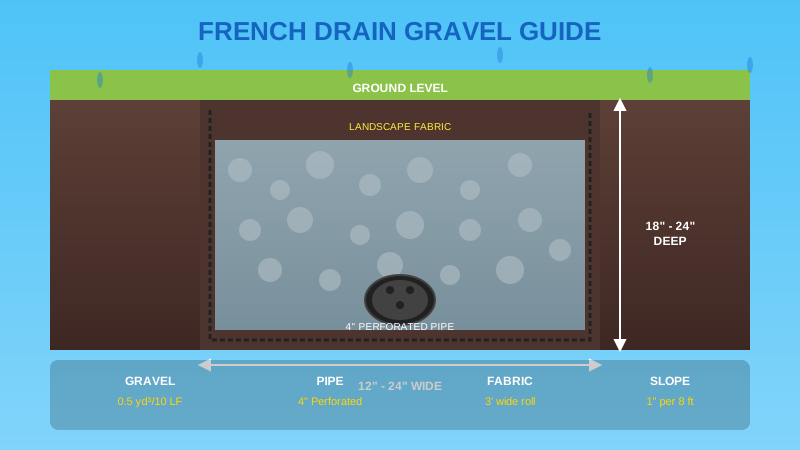
Most gravel orders go wrong because the area is right but the depth is not. A driveway needs the right surface layer and the right base below it. Pick the build-up before you calculate yards or tons.
If you want the math done for you, start with the Gravel Calculator.
Start With the Right Gravel Layer Strategy
There is no single “correct” driveway depth for every project. A decorative parking pad, a long rural driveway, and a heavy truck lane do not use the same build-up.
For most residential jobs, think in layers:
| Project Type | Surface Gravel | Base Layer | Common Total Build |
|---|---|---|---|
| Walkway or garden path | 2-3 in. | 0-2 in. | 2-4 in. |
| Light residential driveway | 3-4 in. | 4-6 in. compacted base | 7-10 in. |
| Soft soil or frequent vehicle traffic | 3-4 in. | 6-8+ in. compacted base | 9-12+ in. |
| Drainage swale / trench fill | Varies | Varies | Depends on design |
Keep two rules in mind:
- Driveway surface gravel is usually not the full structural depth.
The visible top layer may be 3-4 inches, but it often sits on a compacted base layer. - Weak subgrade needs more stone, not less.
Clay, wet soil, and repeated vehicle traffic usually push the project toward a thicker base.
If you also need to raise or level the area, use the Dirt Calculator too. It helps you size the subgrade before the stone goes down.
Which Gravel Type Works Best for Driveways?
Rounded stone looks attractive, but it is not always the best choice for driveways.
Best all-around choice: angular crushed stone
Crushed stone locks together better than rounded rock. That helps the surface resist ruts and washout. Many residential driveways use:
- a larger crushed stone for the lower base,
- a mid-size crushed stone for the working layer,
- and sometimes a finer top course for the finished surface.
When pea gravel makes sense
Pea gravel works better for:
- decorative paths,
- patios,
- low-traffic garden areas,
- and projects where barefoot comfort matters more than vehicle stability.
For a true driveway, pea gravel often shifts too much. It works best when the base and edging are excellent.
How to Convert Area and Depth Into Cubic Yards
Once you know the depth, the math is simple:
Cubic feet = length × width × depth in feet
Cubic yards = cubic feet ÷ 27
If your depth starts in inches, convert it first:
Depth in feet = inches ÷ 12
Example 1: 10×20 driveway at 4 inches
- Area:
10 × 20 = 200 sq ft - Depth:
4 in. = 0.333 ft - Cubic feet:
200 × 0.333 = 66.6 - Cubic yards:
66.6 ÷ 27 = 2.47
That 4-inch surface layer needs about 2.5 cubic yards before compaction and waste.
Example 2: 12×40 driveway at 5 inches
- Area:
12 × 40 = 480 sq ft - Depth:
5 in. = 0.417 ft - Cubic feet:
480 × 0.417 = 200.2 - Cubic yards:
200.2 ÷ 27 = 7.41
That surface layer needs about 7.4 cubic yards before overage.
How to Convert Cubic Yards Into Tons
Suppliers often sell driveway stone by the ton rather than the cubic yard. Use this planning range:
- 1.4 to 1.5 tons per cubic yard for many crushed gravels
- slightly less for some lighter decorative products
- more for dense or wet material
The formula is:
Tons = cubic yards × tons per cubic yard
Using the 10×20 example above:
2.47 yd³ × 1.4 = 3.46 tons2.47 yd³ × 1.5 = 3.71 tons
That means a typical order might land near 3.5 to 3.8 tons before you add overage.
Why Smart Orders Usually Include Overage
Field conditions rarely match perfect math. Most homeowners order a little extra because:
- gravel compacts after placement,
- subgrade is rarely perfectly flat,
- some material gets lost during spreading,
- and edge transitions often consume more than expected.
A good starting point is 10-15% overage on most residential driveway jobs. Add more if the site is rough or out of level.
A 10 by 20 driveway at 4 inches can jump to about 2.8-3.0 cubic yards from 2.47. That extra volume covers real field conditions.
Common Gravel Driveway Depth Mistakes
1. Treating the surface layer as the full structure
A 3-inch surface layer will not solve rutting if the driveway sits on weak ground.
2. Using decorative stone where angular stone is needed
A driveway must handle turning tires, rain, and repeated compression. Rounded rock often moves too much in those conditions.
3. Forgetting compaction
Loose stone volume and finished compacted depth are not the same thing. A driveway planned to finish at 4 inches may need a larger delivered volume.
4. Ignoring drainage
Stone thickness cannot fully compensate for poor slope or trapped water. If water stays in the section, the driveway usually fails earlier.
5. Skipping the material density check
If the supplier quotes in tons, ask what density they are using so your yard-to-ton conversion matches the real material.
A Simple Ordering Workflow That Prevents Rework
Before ordering, walk through this checklist:
- Measure length and width accurately.
- Decide whether you are estimating the surface only or the full driveway build.
- Split the job into layers if the base and finish stone are different.
- Convert each layer into cubic yards.
- Convert yards into tons using the supplier’s density.
- Add reasonable overage for compaction and uneven grade.
Then use the Gravel Calculator to confirm the numbers. If the site also needs grading, backfill, or finish soil at the edges, use the Topsoil Calculator and Dirt Calculator. They help you budget the rest.
Final Takeaway
For many residential driveways, the visible gravel surface ends up around 3-4 inches. The real project depth is usually greater once the compacted base is included. That is why the best estimates start with the section design, not just the top layer.
Choose the layer strategy first, then run the yardage and tonnage math. That one change prevents under-ordering, helps with supplier quotes, and makes the calculator far more accurate.
How we checked this page
- • Formulas checked against trade and source material
- • Verified against: Landscape material coverage and delivery references, Supplier tonnage / cubic-yard conversion assumptions, Current U.S. landscaping material pricing benchmarks
- • Price ranges used for planning, not as fixed quotes
- • This landscaping content is scoped for U.S. planning and estimating workflows, not for stamped engineering or permit approval.
- • We review formulas, material assumptions, and practical steps against category-appropriate references before publishing updates.
- • We refresh pages when calculator logic, supplier assumptions, or pricing guidance materially changes.
- • Readers should confirm final dimensions, structural requirements, and local code obligations with qualified local professionals.