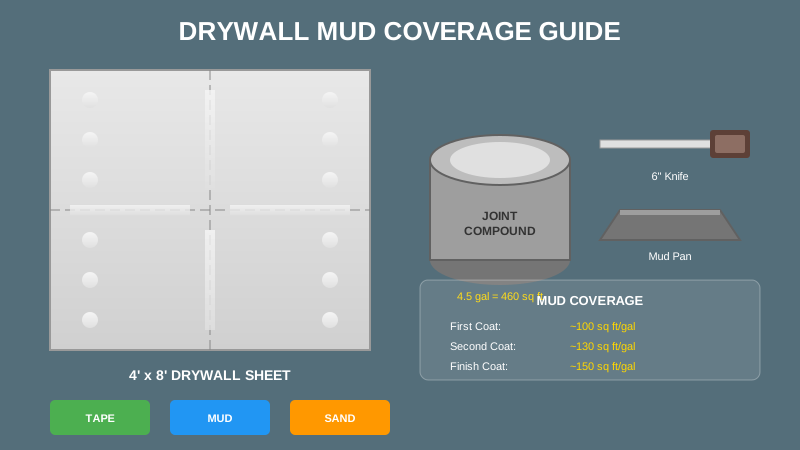
Drywall mud is cheap, but wasted buckets still add up. Too little slows the job. Too much leaves you with extra weight in the garage. Estimate the compound, tape, screws, and texture before you start.
Quick Coverage Rule
1 gallon of joint compound covers 100 square feet (one coat)
Most jobs need 3 coats. So plan for:
3 gallons per 100 square feet of drywall
Joint Compound Coverage Table
| Container Size | Covers (per coat) | Covers (3 coats) |
|---|---|---|
| 1 gallon | 100 sq ft | 33 sq ft |
| 3.5 gallon | 350 sq ft | 116 sq ft |
| 4.5 gallon | 450 sq ft | 150 sq ft |
| 5 gallon | 500 sq ft | 166 sq ft |
Based on standard finishing with Level 4 smoothness
Types of Joint Compound
Different muds for different jobs.
All-Purpose (Most Common)
- Good for taping and finishing
- Easy to sand
- Longer drying time
- Coverage: 100 sq ft per gallon
Lightweight
- Easier to sand
- Less weight per bucket
- Faster drying
- Coverage: 120 sq ft per gallon
Setting-Type (Hot Mud)
- Sets by chemical reaction
- Won’t shrink
- Harder to sand
- Coverage: 80 sq ft per gallon
Topping Compound
- Finish coats only
- Very smooth texture
- Easy sanding
- Coverage: 130 sq ft per gallon
Calculate Your Room
Step 1: Measure Wall Area
Wall Area = Perimeter × Height
Example: 12×14 room, 8 ft ceiling
- Perimeter: (12 + 14) × 2 = 52 feet
- Wall Area: 52 × 8 = 416 sq ft
Step 2: Measure Ceiling
Ceiling = Length × Width
- Ceiling: 12 × 14 = 168 sq ft
Step 3: Total Drywall
Total: 416 + 168 = 584 sq ft
Step 4: Calculate Mud Needed
Mud = Total Area ÷ 166 (for 5-gal bucket, 3 coats)
584 ÷ 166 = 3.5 buckets → Order 4 buckets
Room Size Quick Reference
| Room Size | Walls + Ceiling | 5-Gal Buckets |
|---|---|---|
| 10×10 | 420 sq ft | 3 |
| 12×12 | 528 sq ft | 4 |
| 12×14 | 584 sq ft | 4 |
| 14×16 | 712 sq ft | 5 |
| 16×20 | 896 sq ft | 6 |
Assumes 8-foot ceilings, 3-coat finish
Tape Coverage
Joint tape covers every seam and corner.
Paper Tape
- Comes in 250 or 500 ft rolls
- Use 1 foot per linear foot of seam
- Butt joints need extra
Mesh Tape
- Self-adhesive
- Faster application
- Needs setting compound for first coat
How Much Tape?
Linear feet of seams = (Room perimeter × 2) + (Ceiling length × number of sheets)
Example: 12×14 room with 4×8 sheets
- Wall seams: 52 × 2 = 104 feet
- Ceiling seams: Approximately 40 feet
- Corners: 32 feet (4 corners × 8 ft)
- Total: 176 feet → One 250-ft roll
Screw Coverage
You need screws to hang the drywall first.
| Sheet Size | Screws per Sheet |
|---|---|
| 4×8 (32 sq ft) | 28-32 |
| 4×12 (48 sq ft) | 40-48 |
Rule: 1 pound of screws covers about 200 sq ft
Complete Material List
For 500 sq ft room:
| Material | Quantity | Cost Est. |
|---|---|---|
| All-purpose mud (5 gal) | 3 buckets | $45 |
| Paper tape (500 ft) | 1 roll | $8 |
| Corner bead (8 ft) | 4 pieces | $20 |
| 1-5/8” screws (1 lb) | 3 boxes | $24 |
| Sandpaper (150 grit) | 1 pack | $10 |
| Total | $107 |
Application Tips
First Coat (Tape Coat)
- Apply thin layer of mud
- Embed tape immediately
- Remove excess with 6” knife
- Uses most mud
Second Coat (Fill Coat)
- Cover tape and screws
- Feather edges 2-3 inches beyond first coat
- Use 10” knife
Third Coat (Finish Coat)
- Light application
- Feather edges to blend
- Use 12” knife
- Uses least mud
Texture Coverage
Adding texture? Here’s additional mud needed:
| Texture Type | Extra Mud Needed |
|---|---|
| Orange peel | +25% |
| Knockdown | +35% |
| Skip trowel | +40% |
| Popcorn (ceiling) | +50% |
| Smooth (Level 5) | +15% |
Common Mistakes
- Buying too little - Run out mid-coat, color variation
- Too thick coats - Shrinks, cracks, hard to sand
- Not enough drying time - Bubbles and ridges form
- Wrong knife size - Feather with wider blade each coat
- Skipping sanding - Texture shows through paint
Pro Tips
- Buy extra - Unopened buckets are returnable
- Thin it down - Add water for smoother finish coats
- Work in one direction - Prevents lap marks
- Sand between coats - Knock off ridges only
- Prime before paint - Mud absorbs paint differently
Drying Times
| Coat | All-Purpose | Setting Type |
|---|---|---|
| 1st | 24 hours | 20-90 min |
| 2nd | 24 hours | 20-90 min |
| 3rd | 24 hours | 20-90 min |
| Before painting | 24-48 hours | 24 hours |
Humidity affects drying. Fan circulation helps.
Use Our Free Calculator
Our Drywall Calculator figures out everything:
- Sheets needed
- Joint compound quantity
- Tape rolls
- Screws and materials
- Complete cost estimate
Enter your room dimensions and get an instant material list.
Rule of Thumb: Plan for 0.05 gallons of mud per square foot for a standard 3-coat finish. A 5-gallon bucket handles 166 square feet. When in doubt, buy one extra bucket. It stores well if sealed.
References
- Gypsum Association (drywall resources): https://www.gypsum.org/
- USG Sheetrock (product and application resources): https://www.usg.com/
How we checked this page
- • Formulas checked against trade and source material
- • Verified against: GA-216 (Gypsum Board Application), ASTM C840 (Gypsum Board)
- • Price ranges used for planning, not as fixed quotes
- • Examples checked in the live calculator
- • Example quantities and explanations on this page are cross-checked against the matching live calculator on TheSiteMath.
- • This drywall content is scoped for U.S. planning and estimating workflows, not for stamped engineering or permit approval.
- • We review formulas, material assumptions, and practical steps against category-appropriate references before publishing updates.
- • We refresh pages when calculator logic, supplier assumptions, or pricing guidance materially changes.
- • Readers should confirm final dimensions, structural requirements, and local code obligations with qualified local professionals.