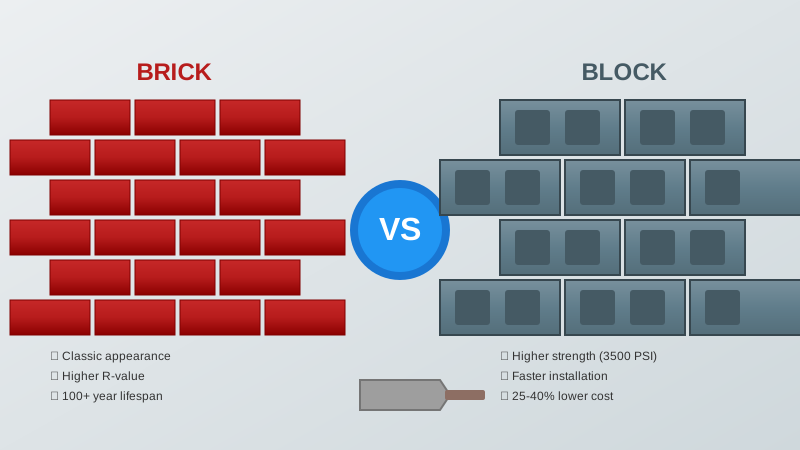
Choosing between CMU and poured concrete changes cost, labor, reinforcement, and waterproofing. Both systems work. Neither is best for every job. Compare them before you estimate materials or hire the work.
If you want quantities first, start with the Concrete Block Calculator or the Concrete Calculator.
Quick Comparison Table
Use this chart to get oriented before you talk to suppliers or contractors.
| Decision Factor | Concrete Block (CMU) | Poured Concrete |
|---|---|---|
| Typical install method | Unit-by-unit masonry | Forms + concrete placement |
| Small-wall DIY potential | Better for some non-structural walls | Usually harder for DIY |
| Speed on simple small jobs | Moderate | Setup can be heavy for small jobs |
| Monolithic wall strength | Good with proper reinforcement | Usually stronger as one continuous placement |
| Waterproofing demands | More joints to manage | Fewer joints, but still needs waterproofing |
| Repair flexibility | Individual units can sometimes be replaced | Repairs are less modular |
| Material takeoff style | Block count + mortar + grout + rebar | Cubic yards + reinforcement + formwork |
That table is only the start. The correct answer depends on wall purpose, site conditions, reinforcement, and local engineering requirements.
When Concrete Block Makes More Sense
Concrete block is often the better fit when the project benefits from a modular wall system.
CMU often wins for:
- garden and site walls,
- some privacy walls,
- many small retaining walls,
- partition and screen walls,
- and projects where block appearance or incremental installation matters.
Why builders choose CMU
-
Material quantities are easy to break down.
You can estimate blocks, mortar, grout, and rebar in visible units. -
It can be practical for staged work.
On smaller jobs, block installation can feel more manageable than forming and pouring a wall all at once. -
It works well for many above-grade and moderate-scale wall applications.
If CMU looks like the better fit, run the Concrete Block Calculator. It turns wall size into block, mortar, grout, and rebar quantities.
When Poured Concrete Is the Better Choice
Poured concrete is often the stronger default when you need a continuous structural wall with fewer joints.
Poured concrete often wins for:
- foundation walls,
- high-load retaining conditions,
- below-grade structural walls,
- monolithic structural work,
- and projects already set up for forms, placement, and finishing.
Why poured concrete gets specified
-
It creates a continuous wall.
That can simplify certain structural and water-management goals. -
It reduces the number of mortar joints.
Fewer joints does not mean waterproof by default, but it does change the wall behavior and detailing. -
It can align better with foundation-wall workflows.
If poured concrete looks like the better fit, use the Concrete Calculator. It gives you wall volume and bag or ready-mix quantities fast.
Cost: Which System Is Usually Cheaper?
This is where many people expect one universal answer. In reality, cost changes by wall type.
CMU can be cost-effective when:
- the wall is not overly tall or complex,
- labor is readily available,
- the site does not favor heavy formwork,
- and the project benefits from modular installation.
Poured concrete can be cost-effective when:
- the wall is already structural and heavily reinforced,
- the project is foundation-oriented,
- the crew is set up for forms and concrete placement,
- or the wall geometry makes block labor inefficient.
A useful rule of thumb is:
- small site walls often keep CMU in the conversation,
- serious below-grade structural walls often pull the job toward poured concrete sooner.
For CMU-specific budgeting, see Concrete Block Wall Cost Per Linear Foot.
Strength Is Not Just About the Material Name
People often ask which wall is “stronger.” The honest answer is that wall performance depends on:
- reinforcement,
- footing design,
- soil loads,
- wall height,
- grout schedule,
- concrete strength,
- and overall engineering.
Why the comparison can be misleading
A lightly built block wall is not the same as an engineered reinforced CMU wall. A small poured garden wall is not the same as a structural foundation wall.
Ask this instead:
“Is block or poured concrete stronger?”
It is:
“Which system is better for this wall height, this soil pressure, this location, and this structural requirement?”
That is the question building departments, engineers, and good contractors actually answer.
Waterproofing and Moisture Behavior
Neither system should be treated as automatically waterproof.
With CMU
More joints and more cells mean more detail work. Pay close attention to:
- grout detail,
- drainage detail,
- coatings or membranes,
- and base / footing water management.
With poured concrete
Poured concrete has fewer joints, but you still need to plan for:
- cracks,
- cold joints,
- hydrostatic pressure,
- drainage,
- and exterior waterproofing where required.
Below grade, water management matters as much as wall material.
Which System Is More DIY-Friendly?
For many homeowners, small non-structural CMU walls feel easier to handle. The work is modular and easier to stage.
But once the project becomes:
- retaining,
- structural,
- tall,
- below grade,
- or permit-sensitive,
the DIY advantage shrinks fast.
Poured concrete tends to be less forgiving because:
- forms must be accurate,
- the pour sequence matters,
- placement timing matters,
- and mistakes are harder to reverse once concrete is placed.
That is why many DIY projects stop at garden walls and freestanding site walls. Foundation and engineered retaining work usually move to pros.
A Better Decision Workflow
If you are stuck between systems, use this order:
- Define the wall purpose: privacy, retaining, foundation, partition, or screen wall.
- Decide whether the wall is structural or below grade.
- Check whether joints, waterproofing, and drainage complexity will dominate the job.
- Estimate the CMU option with the Concrete Block Calculator.
- Estimate the poured option with the Concrete Calculator.
- Compare labor, reinforcement, waterproofing, and inspection requirements, not just raw material price.
This turns the choice into a real project decision instead of a vague material preference.
Final Takeaway
Concrete block and poured concrete are not interchangeable shortcuts. Each works best in different contexts:
- CMU often makes sense for modular wall construction, many site walls, and projects where visible unit-by-unit takeoff is helpful.
- Poured concrete often makes more sense for monolithic structural walls, foundation work, and conditions where continuity and structural demand dominate.
If you are still choosing, estimate both systems once. The quantity math usually makes the tradeoff much clearer than opinions alone.
How we checked this page
- • Formulas checked against trade and source material
- • Verified against: NCMA TEK Manual, ACI 318
- • Price ranges used for planning, not as fixed quotes
- • Examples checked in the live calculator
- • Example quantities and explanations on this page are cross-checked against the matching live calculator on TheSiteMath.
- • This masonry content is scoped for U.S. planning and estimating workflows, not for stamped engineering or permit approval.
- • We review formulas, material assumptions, and practical steps against category-appropriate references before publishing updates.
- • We refresh pages when calculator logic, supplier assumptions, or pricing guidance materially changes.
- • Readers should confirm final dimensions, structural requirements, and local code obligations with qualified local professionals.