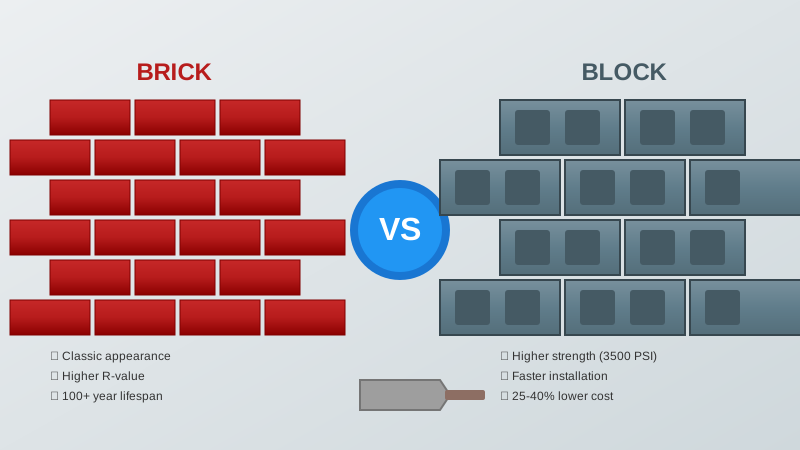
Brick and concrete block do different jobs well. Brick gives you a finished look and strong weather resistance. Concrete block goes up faster and handles structural work well. Compare cost, strength, insulation, and best-fit use before you buy.
The Fundamental Differences
Before comparing performance, let’s understand what we’re comparing:
What is Brick?
Traditional bricks are made from clay that’s molded and fired in a kiln at temperatures exceeding 2,000°F. This process creates a dense, durable unit with distinctive color and texture.
Standard Dimensions:
- Modular brick: 3-5/8” × 2-1/4” × 7-5/8”
- Standard brick: 3-5/8” × 2-1/4” × 8”
- Weight: 4-5 lbs each
What is Concrete Block?
Concrete blocks (CMU - Concrete Masonry Units) are made from Portland cement, aggregates, and water, then cured under pressure or steam. They come in various configurations—solid, hollow, and specialty shapes.
Standard Dimensions:
- Standard CMU: 8” × 8” × 16” (nominal)
- Actual: 7-5/8” × 7-5/8” × 15-5/8” (to account for mortar joints)
- Weight: 28-35 lbs each (hollow), 40-50 lbs (solid)
Strength Comparison
Compressive Strength
Concrete blocks generally offer superior compressive strength:
| Material | Typical Compressive Strength |
|---|---|
| Standard Concrete Block | 1,900-3,500 PSI |
| High-Strength CMU | 4,500+ PSI |
| Standard Clay Brick | 1,500-3,000 PSI |
| Engineering Brick | 5,000-10,000 PSI |
Key Insight: While concrete blocks have higher average compressive strength, engineering-grade bricks can exceed most CMU. The right choice depends on your specific structural requirements.
Flexural (Bending) Strength
Flexural (bending) performance depends on unit type, mortar, grout/reinforcement, and design. In many real-world applications, brick masonry performs well in bending and is commonly used for:
- Retaining walls subject to lateral pressure
- Facades exposed to wind loads
- Structures in earthquake-prone areas (when properly reinforced)
Load-Bearing Applications
For load-bearing walls:
- Foundations: Concrete block is standard (filled with rebar and grout)
- Above-grade walls: Both work well, but CMU is faster to install
- Retaining walls: Wall thickness and reinforcement should be engineered based on loads, soil, and local code
Cost Analysis: 2025 Pricing
Material costs tell only part of the story—labor often represents 50-70% of total masonry costs.
Material Costs
| Material | Cost per Unit | Coverage | Cost per Sq Ft |
|---|---|---|---|
| Standard Clay Brick | $0.50-1.50 | 7 per sq ft (modular) | $3.50-10.50 |
| Face Brick (premium) | $1.00-3.00 | 7 per sq ft | $7.00-21.00 |
| Standard CMU (8×8×16) | $1.50-3.00 | 1.125 per sq ft | $1.70-3.40 |
| Split-Face CMU | $2.50-5.00 | 1.125 per sq ft | $2.80-5.60 |
Labor Costs
This is where concrete block shines:
| Task | Bricks per Hour | CMU per Hour |
|---|---|---|
| Experienced Mason | 300-500 | 60-100 |
| Average Coverage/Day | 200-300 sq ft | 100-150 sq ft (more sq ft per unit) |
Why CMU is Faster:
- Fewer units to lay (1 CMU ≈ 8+ bricks in coverage)
- Larger mortar joints are more forgiving
- Lighter per square foot coverage
Total Installed Costs (2025)
| Wall Type | Brick (per sq ft) | CMU (per sq ft) |
|---|---|---|
| Basic structural | $12-18 | $8-14 |
| Finished/decorative | $20-35 | $12-22 |
| Premium/custom | $35-60+ | $20-35 |
Bottom Line: Concrete block often costs less to build with, but labor, finish, and local requirements can change the gap.
Thermal Performance
Insulation matters for energy efficiency and occupant comfort.
R-Value Comparison
| Material | R-Value (per inch) | Typical Wall R-Value |
|---|---|---|
| Solid Clay Brick | 0.2 | R-0.8 (4” wall) |
| Hollow CMU | 0.1-0.2 | R-0.8-1.7 (8” wall) |
| Insulated CMU | 1.0-2.5 | R-8-20 (filled cores) |
| Brick Cavity Wall | N/A | R-3-5 (with air gap) |
Advantages:
- Brick has a higher R-value per inch, making it slightly better for thin walls
- CMU with filled cores can achieve excellent insulation when filled with foam or vermiculite
- Both benefit from cavity wall construction with additional insulation
Thermal Mass
Both materials excel at thermal mass—storing and slowly releasing heat:
- Moderates indoor temperature swings
- Reduces heating/cooling loads
- Works best in climates with hot days and cool nights
Brick has a slight edge due to higher density, but the practical difference is minimal.
Durability and Lifespan
Longevity
| Material | Expected Lifespan | Examples |
|---|---|---|
| Clay Brick | 100-500+ years | Ancient Roman structures still standing |
| Concrete Block | 75-100+ years | First CMU buildings (early 1900s) still in use |
Key Factors Affecting Lifespan:
- Freeze-thaw resistance: Both perform well when properly specified; brick may have slight edge
- Chemical resistance: CMU better resists acids; brick better against alkalis
- Salt damage: Brick more susceptible to efflorescence; CMU to sulfate attack
- Maintenance: Brick requires less maintenance over time
Fire Resistance
Both materials are excellent fire barriers:
| Assembly | Fire Rating |
|---|---|
| 4” solid brick | 1-2 hours |
| 4” CMU (hollow) | 1 hour |
| 8” CMU (grouted) | 4 hours |
| 8” brick (solid) | 4 hours |
For fire-rated assemblies, concrete block is often preferred because grouted hollow cores can achieve high ratings economically.
Aesthetic Considerations
Brick Advantages
- Timeless appeal: Classic look that never goes out of style
- Color variety: Natural earth tones, or manufactured in virtually any color
- Texture options: Smooth, tumbled, wire-cut, sand-faced
- Pattern possibilities: Running bond, herringbone, basket weave, soldier course
- Premium perception: Higher perceived value in residential real estate
CMU Advantages
- Modern aesthetic: Clean lines suit contemporary architecture
- Consistent sizing: Easier to achieve precise dimensions
- Surface treatments: Split-face, ground-face, burnished, scored
- Versatility: Can be painted, stuccoed, or veneered
- Architectural blocks: Decorative units available for visual interest
Resale Value Impact\n\nBrick exteriors are often perceived as premium and can improve curb appeal. Any resale impact varies widely by region, comparable homes, and overall condition.\n\n## Best Applications for Each Material
When to Choose Brick
| Application | Why Brick Works Best |
|---|---|
| Residential facades | Aesthetic appeal, perceived value |
| Historic restoration | Period authenticity |
| High-visibility commercial | Premium appearance |
| Thin veneer applications | Lighter weight options available |
| Curved walls | Easier to create smooth curves |
| Landscape features | Patios, walkways, garden walls |
When to Choose Concrete Block
| Application | Why CMU Works Best |
|---|---|
| Foundations | Higher compressive strength, moisture resistance |
| Load-bearing walls | Strength, speed, cost efficiency |
| Commercial/industrial | Fast installation, lower cost |
| Sound walls | Excellent acoustic properties |
| Fire-rated assemblies | Easy to achieve high ratings |
| Below-grade construction | Better moisture resistance |
Hybrid Approach: Best of Both Worlds
Many successful projects combine both materials:
- CMU structural walls with brick veneer exterior
- Brick foundation to grade, CMU above with stucco
- CMU interior walls with brick accent features
This approach leverages the structural advantages of concrete block while maintaining the aesthetic appeal of brick where it matters most.
Installation Considerations
Skill Requirements
| Task | Brick Difficulty | CMU Difficulty |
|---|---|---|
| Basic wall | Moderate | Easy-Moderate |
| Corners | Moderate | Easy |
| Openings | Difficult | Moderate |
| Patterns/bonds | Difficult | N/A (limited options) |
| Curved walls | Very Difficult | Difficult |
Weather Sensitivity
Both materials have similar weather installation requirements:
- Temperature: Don’t lay below 40°F without protection
- Rain: Cover fresh mortar from direct rain
- Hot weather: Keep materials cool, mortar moist
- Wind: Protect fresh work from rapid drying
Mortar Requirements
| Joint Type | Brick | CMU |
|---|---|---|
| Typical joint width | 3/8” | 3/8” |
| Mortar type | Type N or S | Type S or N |
| Mortar per 100 units | 3-4 cu ft | 4.5-5 cu ft |
Environmental Impact
Sustainability is increasingly important in construction:
Carbon Footprint
| Material | CO2 Emissions |
|---|---|
| Traditional Brick | 26-27.3 kg CO2e/m² |
| Concrete Block | 15-20 kg CO2e/m² |
Note: Brick manufacturers have reduced emissions by approximately 8 kg CO2e/m² since 2015, and the gap is closing.
Sustainability Factors
Brick Advantages:
- Made from abundant natural clay
- No chemical additives required
- Recyclable and reusable
- Can last centuries (embodied carbon amortized over long life)
CMU Advantages:
- Can incorporate recycled aggregates (up to 50%)
- Lower manufacturing energy
- More efficient transportation (more coverage per truckload)
- Hollow cores reduce material use
Making Your Decision
Choose Brick If:
- Aesthetic appeal is a top priority
- You’re building residential or high-end commercial
- Long-term value and durability matter most
- Historic or traditional appearance is desired
- Budget allows for higher initial investment
Choose Concrete Block If:
- Cost efficiency is the primary concern
- You’re building foundations or below-grade structures
- Speed of construction is important
- Fire ratings are a requirement
- The structure will be clad or finished anyway
Choose Both If:
- You want structural efficiency with aesthetic appeal
- Budget allows for strategic brick placement
- You’re building a hybrid commercial-residential project
Calculate Your Materials
Need exact masonry numbers? Use these calculators:
- Masonry Calculator: For brick walls, mortar, and accessories
- Concrete Block Calculator: For CMU walls and grout requirements
Bottom Line: Neither material wins every job. Concrete block usually wins on speed and structure. Brick usually wins on finish and curb appeal.
References
- ASTM C62 (Building Brick): https://www.astm.org/c0062
- ASTM C90 (Loadbearing Concrete Masonry Units): https://www.astm.org/c0090
- ASHRAE Handbook—Fundamentals (thermal properties): https://www.ashrae.org/technical-resources/ashrae-handbook
- NCMA TEK resources (CMU design guidance): https://ncma.org/resource/tek/
How we checked this page
- • Formulas checked against trade and source material
- • Verified against: NCMA guidance and masonry estimating references, ASTM masonry references where material specifications matter, Current U.S. masonry pricing benchmarks
- • Price ranges used for planning, not as fixed quotes
- • This masonry content is scoped for U.S. planning and estimating workflows, not for stamped engineering or permit approval.
- • We review formulas, material assumptions, and practical steps against category-appropriate references before publishing updates.
- • We refresh pages when calculator logic, supplier assumptions, or pricing guidance materially changes.
- • Readers should confirm final dimensions, structural requirements, and local code obligations with qualified local professionals.